Picture this: a company runs delivery in Jira, layers on an expensive portfolio tool, and still answers the key question ‘do we have the people?’ with a fragile spreadsheet.
It’s 2026. We’re not doing this anymore. You cannot plan delivery without real-time capacity. If a roadmap can’t be staffed, it’s not a plan, it’s a wish list with dates.
Here are the five shifts reshaping PPM and capacity planning this year.
1. Let’s retire the spreadsheets!
Capacity planning is where spreadsheets refuse to die, even when the work lives in Jira. The funny bit? Jira already has the good stuff: assignees, estimates, and dates. What it misses, working calendars, public holidays, and vacation/time off, usually gets copied into yet another sheet. Congratulations: now your plan is slower and wrong in two places.
And it’s never one spreadsheet. It’s one per project manager, each with different tabs and a creative definition of ‘available’. So when someone asks, ‘can we take on this next initiative?’, the answer is hiding in a meeting, three chats, and someone’s desktop.
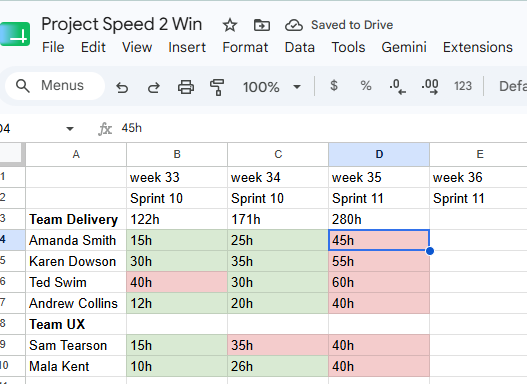
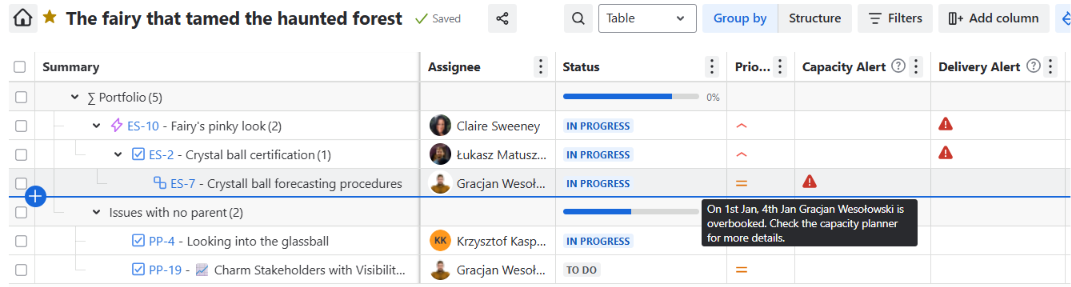
That’s the spreadsheet problem: everyone holds a piece, nobody holds the big picture. Worse, it doesn’t warn you when delivery is about to wobble or a team is about to tip over.
This is where Portfolio by HeroCoders earns its keep. It watches actual Jira data and raises delivery-risk and capacity-risk alerts before the deadline is missed, not during the post-mortem.
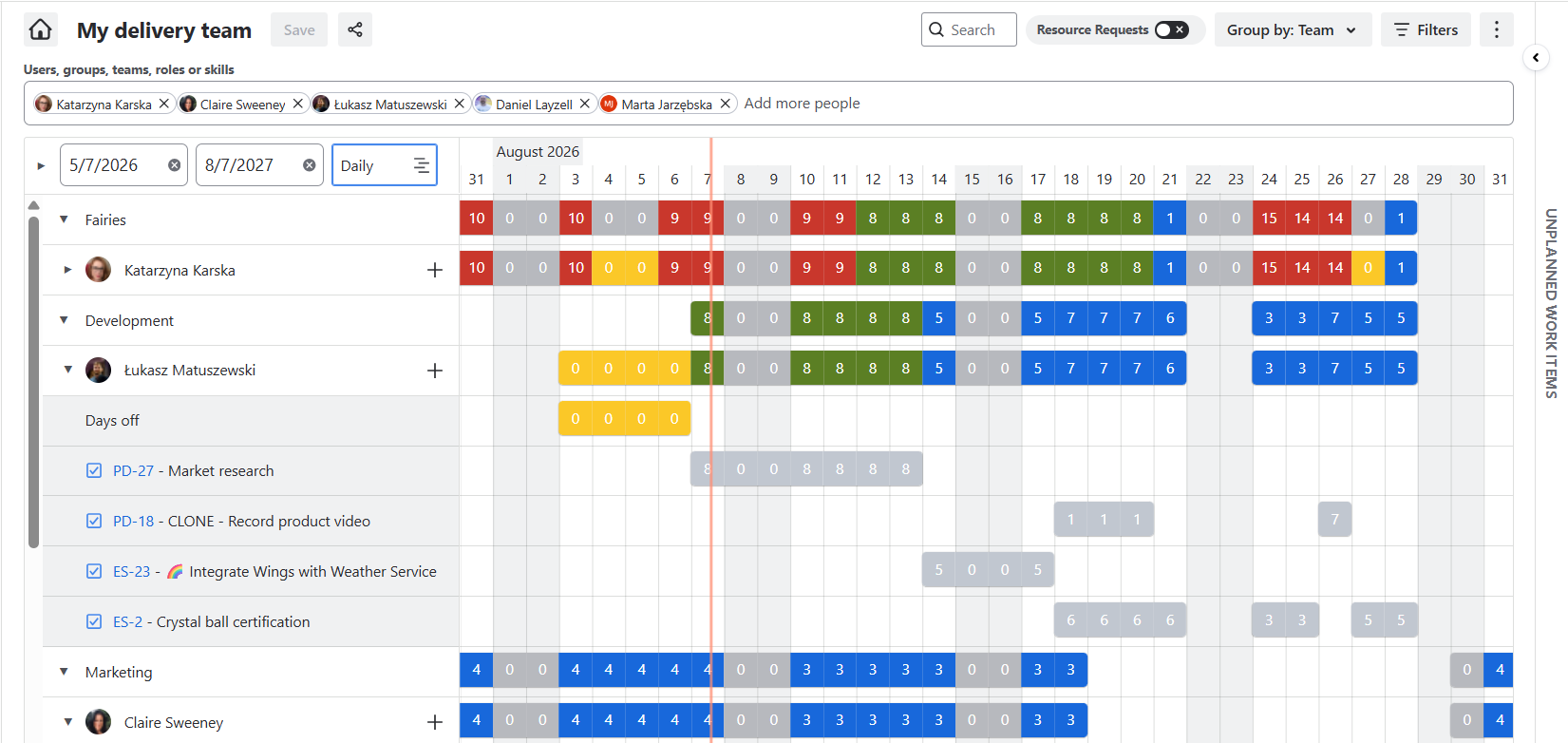
The 2026 version is capacity planning calculated live against real availability, on a timeline that updates as work moves. Overload shows up as a colour, not a Monday-morning panic. Resource allocation doesn’t need to be hard.
Best part: you probably already have enough to start. If Jira work items have assignees, estimates, and dates, Portfolio turns them into real-time capacity on day one. Add working calendars, public holidays, and vacation/time off, and it gets sharper.
Custom time distribution pushes that precision further. Instead of spreading an estimate evenly and hoping reality plays along, Portfolio lets you shape the load across days or weeks, split work assignments and adjust those to reality, reflect part-time availability, and model uneven work patterns. Capacity planning stops being an average and starts matching how teams actually work.
If someone on your team still exports Jira every week to figure out who's drowning, that's the first workflow to put out of its misery.
2. AI that actually earns its place
Look, there's a lot of AI fluff out there. But under the noise, AI can genuinely make your job easier and faster, if it can answer the hard questions, not just the easy ones.
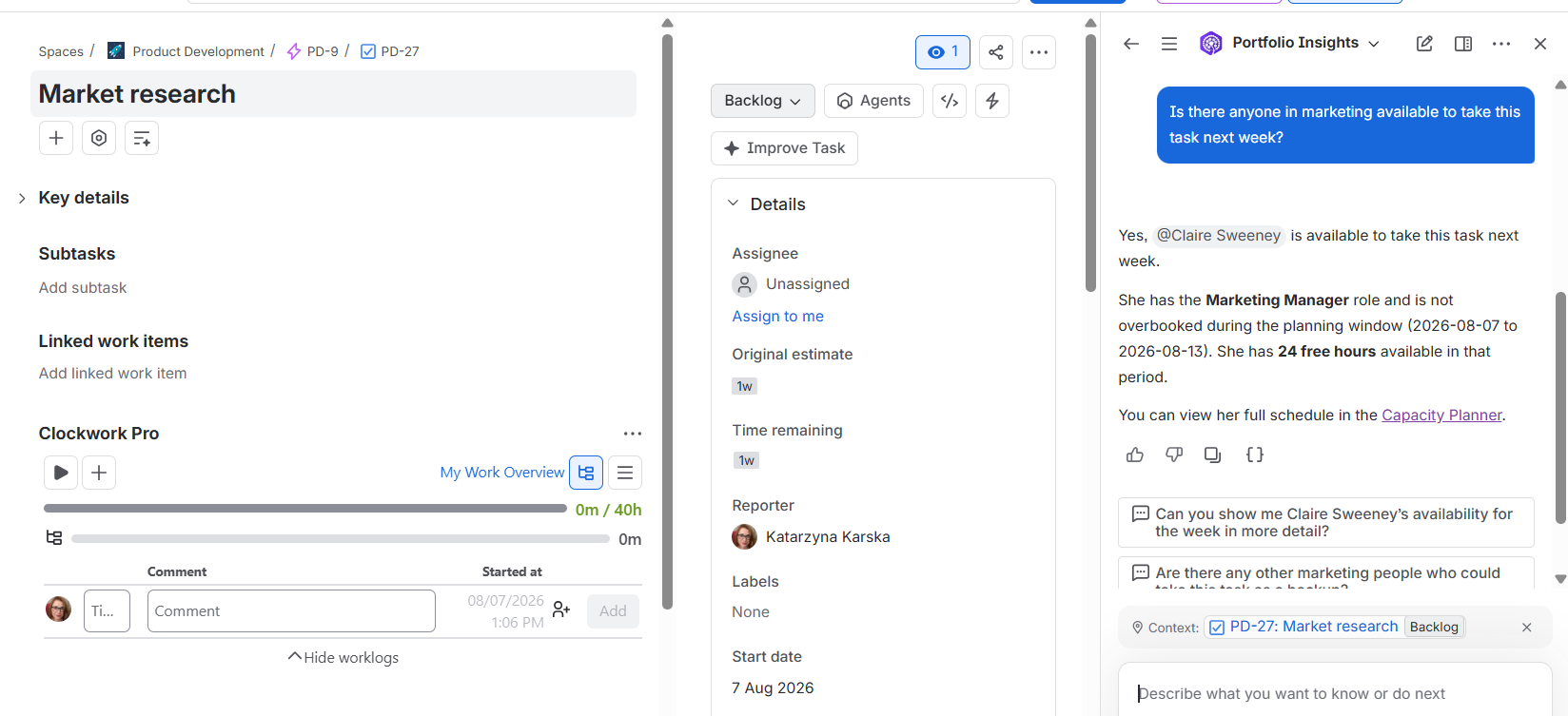
‘Does Jake have capacity to take this task next week?’
‘How much developers capacity do we have next month?'
‘Do we have a Technical Consultant with Salesforce skills available on the week commencing on the 20th?’
‘Is there anyone in Marketing with GEO skills available this week?’
Those are the questions that used to cost you a meeting. The catch is that an AI agent has to be taught how to answer them from your real data, and that's exactly what we do. We teach it how, so you can just ask and get on with your day. And… you ask from anywhere in your Jira, whether you’re on a work item, in your portfolio view. You don’t have to open the Capacity planner to know the answers!
Judge an AI feature by whether it answers your most difficult questions about your work, not by how slick the demo looks.
3. Fewer tools, not more
Quick question: how many apps does it take to support your delivery flow? Count them. Reporting in one, capacity in another, cost somewhere else, time tracking in a fourth…
2026 is the year of cleaning that up. Fewer tools, one source of truth, less to maintain.
One platform that connects everything beats four separate ‘best’ ones that you have to connect by hand or with a scotch tape.
4. 'Where does our data live?' moved to the top of the checklist
Portfolio data is the good stuff: who’s doing what, what’s at risk, plus costs and revenue. And it all runs on Atlassian.
For years, its location was a procurement footnote. Now it’s question #1. Security teams want one thing answered first: does the app copy our data to its own servers, or keep it in our Atlassian environment?
Apps built on Atlassian Forge with the Runs on Atlassian badge keep data in your instance.
That can cut a security review from two months to about a week. In regulated industries, this is often a clear buy or no-buy requirement, not a nice-to-have.
Ask where the data goes early in any evaluation. It often decides your timeline.

5. PPM finally gets its capacity superpower
For years, PPM and capacity planning acted like neighbours who never talked. One had the delivery plan or roadmap. The other had the people. Somehow, leaders were expected to make confident delivery decisions by piecing the story together from both.
That gap is closing fast. In 2026, PPM is not just about what you want to build. It is about whether your teams can actually build it, when they can start, and where the risks are hiding.
That is where Portfolio by HeroCoders fits in. It brings Jira work, real-time capacity planning, resource requests, timelines, costs, and delivery risk into one view, so you can stop guessing and start planning with confidence.
Built on Atlassian Forge, Portfolio keeps your data in your Atlassian environment while giving teams the PPM visibility they need. Less spreadsheet theatre. More decisions you can trust.
The takeaway is capacity planning is no longer a side quest.
Capacity Planning is the engine of modern PPM.
If your tools make you switch apps to connect the two, that gap is costing you predictability.
What big companies get backwards
Big companies often think more scale means a bigger tool, more modules, more setup, more consultants.
In 2026 it's the other way around. Enterprises need more agility and more simplicity,
not less: real-time answers, one connected platform, data that stays where it should, and a setup that doesn't need its own three-month project or a PhD.
Simple is not the basic option anymore. For a large company that just wants to ship, simple is the advantage.
And the AI era only raises the stakes. Everything is speeding up, so you need answers faster too.
A plan you rebuild by hand every week simply can't keep pace with a business that now makes decisions in real time.
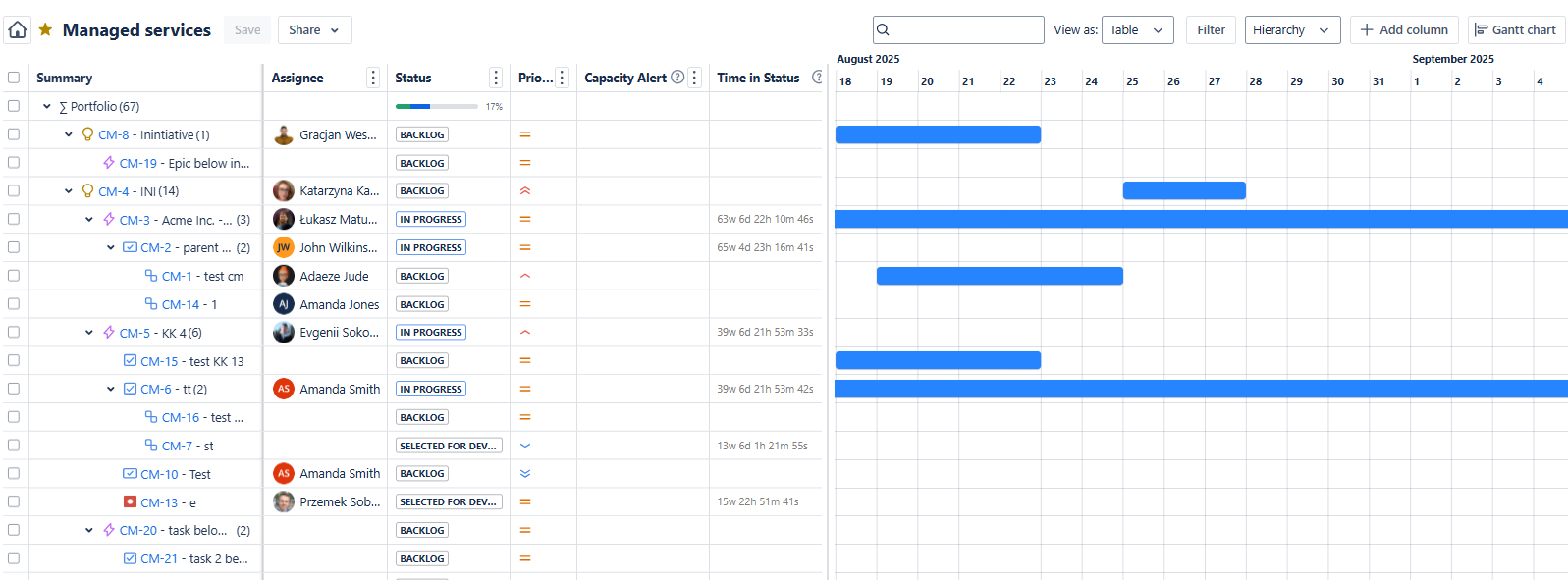
So if you change one thing in 2026, change this: stop planning delivery in a spreadsheet next to a six-figure tool. Put capacity where the work already is - live, on top of Jira.
It's not the '90s. Your planning shouldn't feel like it.
Rethinking your portfolio stack for 2026? See how Portfolio does it, or just start a free trial and put the spreadsheet down.