How and Why to Use Cost & Revenue Fields in Your Jira Portfolio
Portfolio management in Jira often starts with scope, timelines, and capacity. But mature portfolio planning goes further, connecting delivery to financial outcomes. By using the Cost and Revenue fields in Portfolio by HeroCoders, you can move from operational tracking to strategic decision-making.
Instead of asking only “When will this be done?” you can also ask “Is this worth doing?” and “Are we investing in the right initiatives?”
Bringing Financial Context Into Portfolio Planning
The Advanced Edition of Portfolio by HeroCoders supports financial visibility through the Cost and Revenue fields. These values are calculated from time logged on work items and the hourly cost and billing rates configured in Clockwork Pro for Jira.
Cost represents the internal expense associated with completed work. It reflects the actual cost of effort based on predefined user cost rates. Revenue represents the expected income derived from the same logged time, based on billing rates.
Why Financial Visibility Matters at the Portfolio Level
Without cost and revenue data, portfolio decisions are typically based on priority, deadlines, or stakeholder pressure. While these factors are important, they don’t always reflect business value.
When financial data is visible directly in your portfolio:
- You gain clarity on which initiatives generate the highest return relative to investment. A project that consumes significant capacity may not justify its cost, while another smaller initiative could deliver stronger revenue potential.
- You can also identify trends early. If costs are increasing faster than expected revenue, corrective action can be taken before budgets are exceeded. This is particularly important in long-running programs where financial drift is harder to detect without consolidated visibility.
- Forecasting becomes more accurate as historical data accumulates and you compare estimated effort with real cost and revenue outcomes. This enables better planning for future initiatives. Instead of relying purely on story points or rough estimates, you can base forecasts on proven financial patterns.
- Financial data in your portfolio helps leadership evaluate trade-offs more effectively. When capacity is limited, choosing which initiatives to prioritize becomes a financial question as much as a scheduling one.
Real-World Scenarios
In services organizations, cost and revenue fields allow you to monitor profitability in near real time. As time is logged, revenue forecasts update automatically, giving visibility into expected billing before invoices are generated.
In product organizations, cost visibility helps quantify investment in features or strategic initiatives. Even if revenue is indirect, understanding the cost of development enables better evaluation of long-term impact.
For growing companies, these insights are critical. Scaling teams without financial transparency often leads to hidden inefficiencies. Portfolio-level cost tracking helps ensure growth remains sustainable.
How to Get Started
To use Cost and Revenue fields in Portfolio by HeroCoders, you first configure hourly cost and billing rates in Clockwork Pro for Jira. Once rates are defined and time is logged on work items, the calculated values become available as supported fields in Portfolio. You can then add these fields as columns in your Portfolio table view.
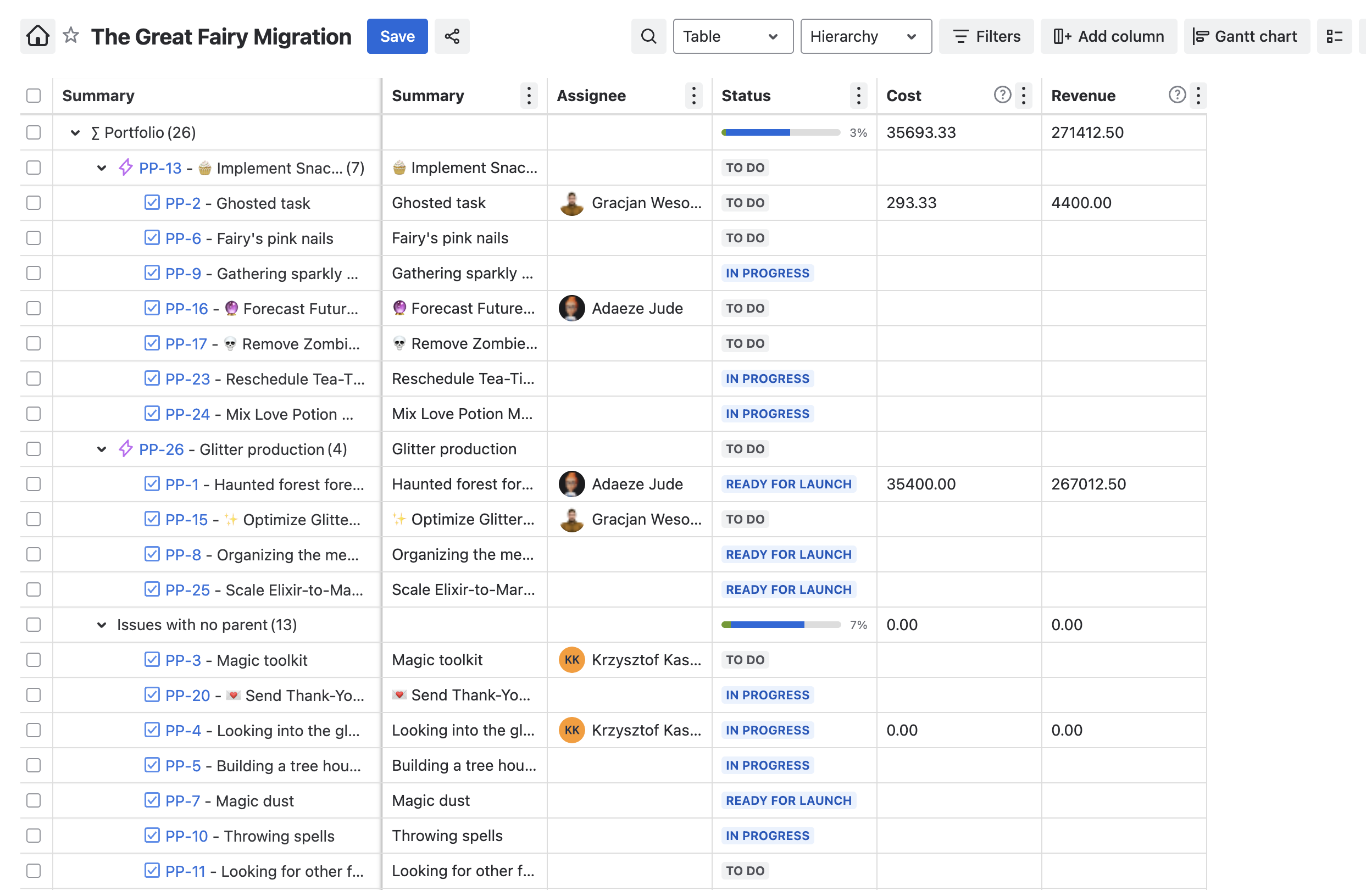
No separate financial reporting tool is required. The insights become part of your existing planning workflow.
From Planning Tool to Strategic Platform
Adding cost and revenue data to your portfolio transforms Jira from a task management system into a strategic business management platform.
You move beyond tracking work. You start evaluating investment.
By combining delivery data with financial context, Portfolio by HeroCoders enables informed prioritization, clearer stakeholder communication, and stronger alignment between execution and business outcomes.
When scope, schedule, capacity, cost, and revenue are visible in one place, portfolio decisions become not just operational — but strategic.