

Having announced the End of Life for its Data Center products, Atlassian is completing its transformation to a cloud-first platform. For organizations with lingering questions about migrating from Jira Data Center to cloud, this article will discuss why now is the best time to migrate, summarize Atlassian’s Enterprise Cloud offering and provide guidance for migrating Marketplace apps, including Checklists for Jira.
Why Migrate to Atlassian Cloud Enterprise
And Why You Should Migrate Now Rather Than Waiting
Atlassian has announced the end of life for its data center products (except BitBucket) for March 28, 2029. While three years appears to be plenty of runway, there are some compelling reasons why organizations can benefit from migrating sooner rather than later. Continuing to work on-prem when the move to cloud is inevitable means you accumulate more technical debt, operational overhead, and security exposure.
It’s also worth remembering that objects on calendars may be closer than they appear!
Faster Innovation and Reduced Operational Burden in Atlassian Cloud
Running Atlassian on-prem requires managing servers, upgrades, networking, security hardening, hardware growth, clustering, disaster recovery, and more. Cloud removes all of that, allowing teams to focus on business value instead of infrastructure.
Along with reduced overhead, Atlassian Cloud’s release cadence delivers:
- Continuous performance improvements
- Security patches with no downtime
- Faster rollout of features and enhancements
- Accelerated development of AI and automation improvements
Teams that delay migration are missing out on these benefits year after year.
Migrating to Atlassian Cloud Lowers Costs
When organizations run a migration cost–benefit analysis, they typically find that Cloud subscriptions are less than the total cost of ownership for running Atlassian products on-prem. Cloud provides lower infrastructure costs (for both hardware and the personnel responsible for maintaining that hardware), reduced security risk, predictable pricing and built-in functionality that can eliminate the need for some third-party tools.
Costs previously dedicated to infrastructure management can be reallocated to innovation, governance, and user experience.
Atlassian Cloud: Built for Real-World Enterprise Scale
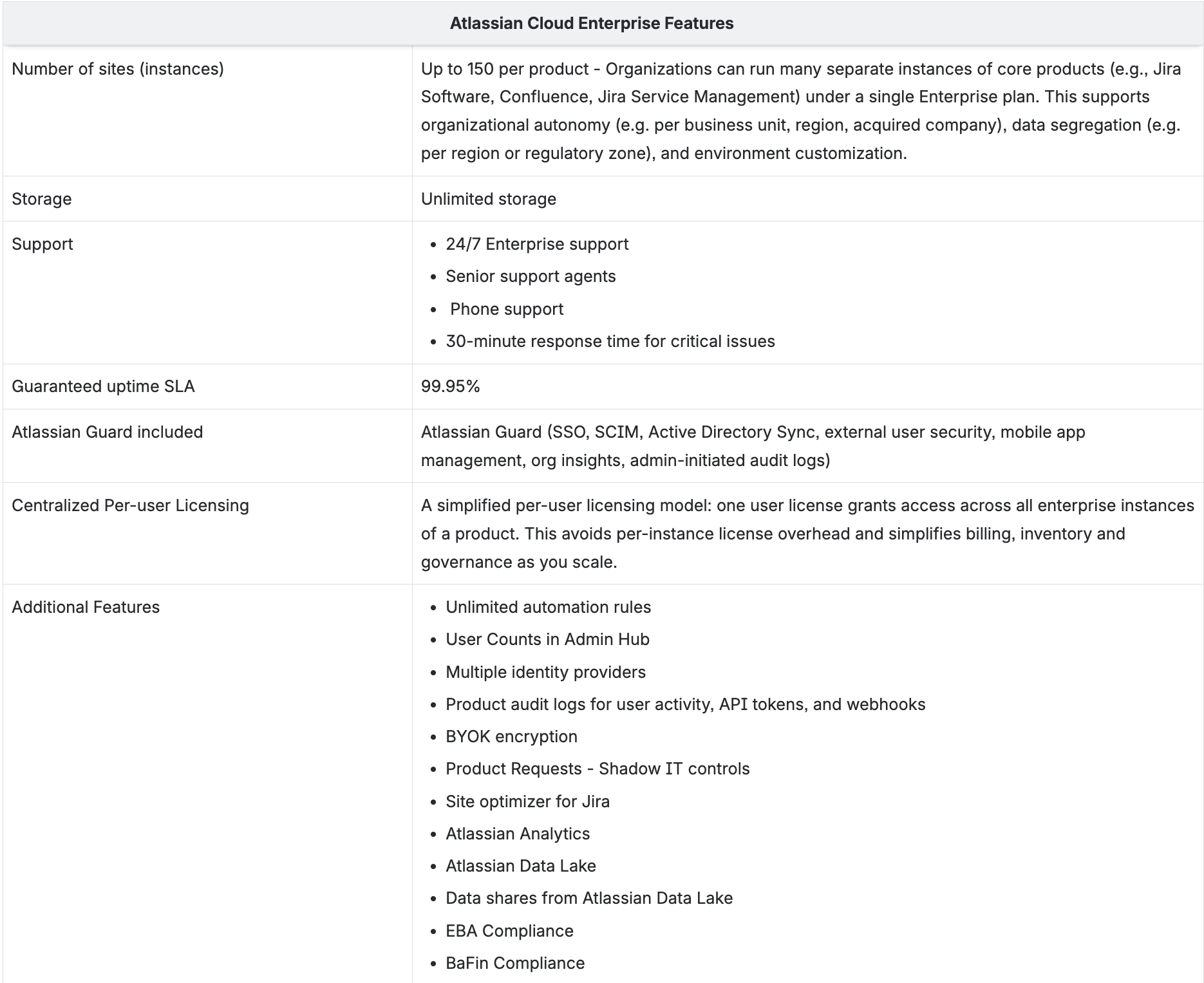
Atlassian Enterprise plans address the needs of large scale organizations with multi-instance support, per-user pricing (across multiple instances), a financially-backed 99.95% uptime SLA, and compliance certifications that are not available in other tiers.
Common Concerns About Migrating to Atlassian Cloud
Atlassian has developed these features to address concerns that are frequently raised by Data Center customers. However, it’s still worth taking a closer look at some of these issues.
Atlassian Cloud Security
Entrusting another entity to house the software that operates your business, as well as your customers' data is a big ask. It’s understandable that many organizations wonder whether a cloud environment can be sufficiently secure. The reality is that Atlassian’s security surpasses most self-managed deployments:
Enterprise Security Architecture
- Encryption in transit (TLS 1.2+) and at rest (AES-256)
- Dedicated security teams (red team, detection & response, product security)
- Always-on patching and continuous vulnerability scanning
- Bug bounty and third-party penetration testing
- Zero-trust posture for Atlassian corporate infrastructure
Atlassian Compliance and Certifications
- ISO 27001, ISO 27018
- SOC 2
- GDPR-aligned privacy controls
- FedRAMP Tailored for select services
- CSA STAR documentation
You can access documentation of Atlassian certifications via their Trust Center.
Identity and Access Control
Cloud Enterprise includes Atlassian Guard Standard, enabling:
- SAML SSO
- SCIM user provisioning and deprovisioning
- Enforced multi-factor authentication
- Session controls, password policies, and API token governance
- Support for major IdPs (Okta, Azure AD, Google Workspace, Ping, etc.)
Atlassian Data Residency
Atlassian supports data residency in a dozen locations across the globe. With Marketplace apps being moved to the Forge platform, you’ll be able to ensure that all of your Jira data is stored in the AWS region of your choosing.
Atlassian Cloud Performance
Atlassian Cloud Enterprise guarantees a 99.95% financially backed SLA, one of the highest offered in the SaaS collaboration ecosystem. Atlassian regularly exceeds this SLA in practice. Here again, Cloud provides higher availability than most self-managed deployments can achieve without significant investment.
Apps & Customizations
Organizations that have been using Atlassian Data Center products for a long time are likely to have invested in customizing their systems and naturally want to bring those customizations with them to the Cloud.
There are now literally thousands of Atlassian Cloud apps. Many apps, including Checklists for Jira, have both on-prem and cloud versions, with similar functionality. Between the Jira Cloud API and the cloud apps available in the Marketplace, you should be able to recreate any of the customizations you currently use on-prem.
Atlassian Cloud Migration
Once you're ready to migrate, Atlassian has a list of tools to help you. Along with the Cloud Migration Assistants for Jira and Confluence, and Cloud Migration Guide, Atlassian has recently introduced FastShift - a program that provides a dedicated team to assist with your cloud migration at no cost. If you’re planning to migrate within the next 2-6 months, this is a great way to get started.
Atlassian Cloud is no longer an alternative to Data Center. It’s the strategic direction of the Atlassian ecosystem. With enterprise-grade security, governance, reliability, and global scale, it now offers capabilities that self-managed systems cannot match without overwhelming cost and complexity.


